We talked about art, Bitcoin and what happens when outsiders stop asking for permission. Somehow, I became friends with the most legendary graffiti artist in Los Angeles.
That still feels surreal to say.
My house is covered in prints of his work. His paintings do more than fill a wall; they change the energy of a room. Every time my eyes wander across the hall, I notice something different: another symbol, another layer, another idea hiding inside the image. MEAR calls his style “Metaphysical Surrealism.” To me, that means painting ideas that cannot be photographed. Power. Consciousness. Corruption. Spirituality. Ancient knowledge. The invisible machinery behind the world we see.
Do you know how the first few seconds of your favorite song can rewire your vibration? MEAR’s work hits me the same way. It pulls you in, forces you to look deeper, and makes you question what is real, who controls the story, and how many people are quietly feeling the same thing.
In a strange way, I had known MEAR’s work for over twenty years before I knew him. He created the cover art for Limp Bizkit’s 7x platinum album, Significant Other. In 1999, that album was loud, confrontational, and tied to a genre critics loved to hate. Yet decades later, people still replay it, defend it, and recognize its cultural impact. What was once dismissed as lowbrow, aggressive, or disposable survived long enough to become nostalgic, influential, and respected.
MEAR’s career follows a similar arc. Graffiti was never supposed to be fine art. It was treated as vandalism, painted over, criminalized, and pushed to the margins. MEAR fought on the front lines for decades. He earned his credibility in the streets long before galleries and collectors caught up.
Bitcoin knows that story all too well.
Governments pushed against it. Banks dismissed it. Regulators tried to contain it. Decentralization became inevitable, and Bitcoin became too big to ignore. Eventually, the same financial system that mocked it began selling Bitcoin ETFs. The establishment often rejects what it cannot control, then adopts it once it becomes impossible to erase.
Bitcoin became a regulated investment product. MEAR’s graffiti became fine art. An album once treated as cultural pollution became a generational landmark. None of them needed permission to matter. They only needed enough people to recognize something real. THIS IS WHERE REVOLUTIONS BEGIN.
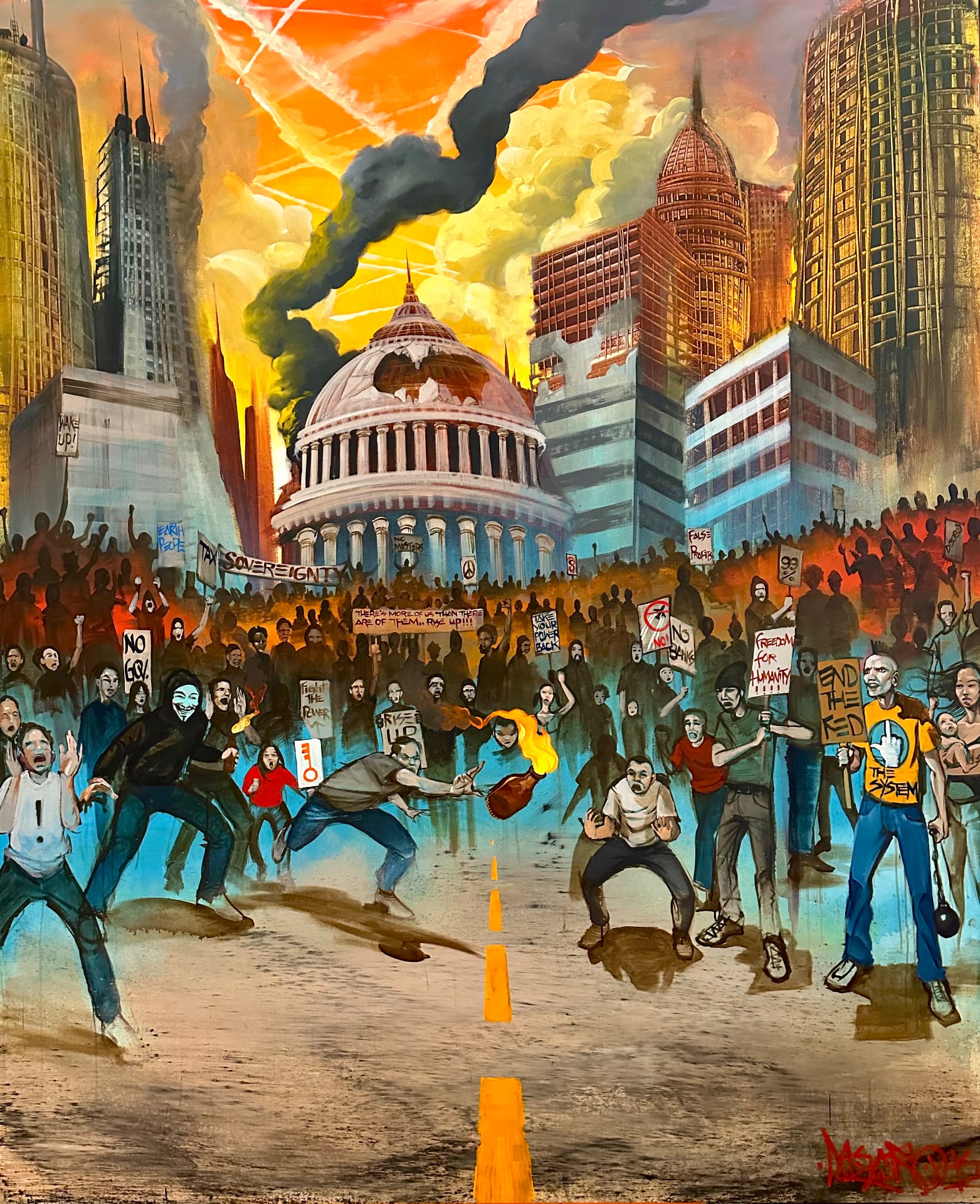
My personal goal is to own an original MEAR painting. I would rather own the right MEAR original than the $100,000 it might cost me. Not because of what the work may become, but because of what it already means to me. At the previous Bitcoin Conference, I watched MEAR spend several days painting “There’s More of Us Than There Are of Them.” As you can see this image perfectly captures the spirit of both his art and Bitcoin.
The painting is available by request, and is on view at BMAG Nashville.